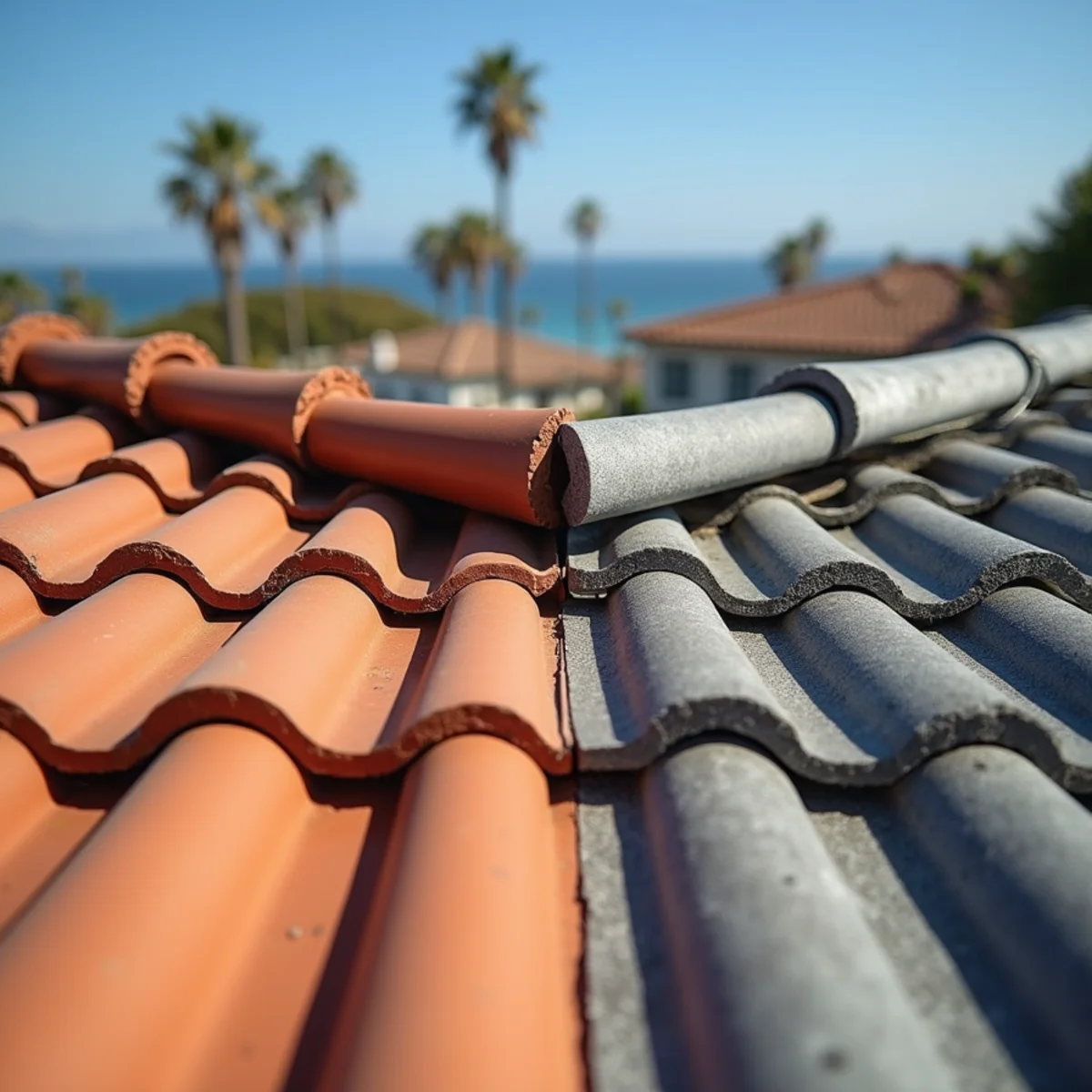
From the street, a clay tile roof and a concrete tile roof can look nearly identical, both giving an Oceanside home that timeless Spanish or Mediterranean character. But they are different materials with real trade-offs in appearance, weight, cost and how they age near the coast. If you are weighing clay tile vs concrete tile for your home, this guide lays the two side by side so the decision comes down to facts rather than guesswork.
Appearance and style
Both tiles can deliver the classic barrel-and-ridge silhouette that suits so much of Southern California's architecture, but they get there differently. Clay tile is fired from natural earthen clay, and its color comes from the clay itself, so it holds that warm, terracotta look for the long haul without fading much. Many homeowners feel nothing quite matches the authenticity of true clay, especially on historic and Spanish-revival homes.
Concrete tile is molded from a sand-and-cement mix and colored with a surface coating or a color blended through the tile. That opens up a much wider menu of shapes and colors, including flat and low-profile styles that mimic slate or wood shake, which is why concrete shows up so often in newer planned communities. The one thing to know is that a surface-applied color can soften or weather over the years, whereas clay's color is essentially permanent. For an owner of a Spanish or Mediterranean home weighing the two, appearance is often the deciding factor.
Weight and structure
Both tile types are heavy, far heavier than asphalt shingles, and that weight has to be carried by the home's framing. Concrete tile is generally the heavier of the two, though the exact difference depends on the specific profile and product. For a home already built for tile, either one is usually fine. For a home moving to tile from a lighter material, a structural check is the responsible first step.
This is a point worth confirming rather than assuming. Whether your roof structure needs reinforcement to carry a given tile is a question for a qualified professional who can evaluate your framing, and where any structural change is involved it may fall under local building requirements you will want to verify with the City. We flag it early because it can affect both the budget and which tile makes sense, not as an alarm, just as part of planning the job properly.
Cost differences
Budget is often where the two part ways. Concrete tile is typically the more affordable option, both for the material itself and sometimes for installation, which is a big reason it dominates newer developments. Clay tends to sit higher on the cost scale, reflecting the material and the craft associated with it.
We will not attach specific dollar figures here, because real pricing swings with your roof's size and pitch, the product chosen, the complexity of the installation and current material costs. The useful takeaway is directional: if first cost is the priority, concrete usually has the edge; if you want the authentic clay look and longevity and the budget allows, clay earns its premium. An on-site estimate is the only way to turn that into real numbers for your home.
Coastal performance
Here is the good news for anyone near the water: both clay and concrete tile handle salt air very well. The tile itself is largely inert, so the salt that corrodes a roof's metal parts has little chemical effect on either material. That makes tile, in general, one of the more coast-friendly surfaces you can put on a home.
The differences at the coast are subtle. Concrete can absorb a bit more moisture than clay and, in consistently damp, shaded spots, may be more prone to surface moss or efflorescence, the whitish mineral bloom that can appear on cement products, though routine cleaning manages it. Clay's fired surface tends to stay cleaner in the marine layer. Either way, the tiles are rarely the coastal weak point. As with every tile roof, the salt does its real damage to the hidden metal and the layer beneath the tile, which brings us to the factor that matters most.
The shared factor: underlayment
Whichever tile you choose, the component that actually keeps your house dry is the underlayment, the water-resistant sheet laid over the wood decking, underneath the tile. Tile sheds the bulk of the water and takes the beating from sun and wind, but it is the underlayment that forms the true waterproof barrier. This surprises a lot of tile-roof owners: the tile can be in excellent shape and the roof can still leak, because the underlayment beneath it has aged out.
And underlayment ages faster than the tile does, especially near the coast, where the marine layer keeps things damp and slows drying. On both clay and concrete roofs, the underlayment will typically need renewal well before the tile reaches the end of its service life. The reassuring part is that this rarely means buying all new tile. In many cases the existing tile can be carefully lifted, the underlayment renewed, and the same tile reset, a far smaller project than a full replacement, and one worth planning for as the roof ages.
A few clues suggest the underlayment, rather than the tile, deserves a look:
- Leaks or ceiling stains even though the tiles themselves look intact
- A tile roof that is several decades old and has never had its underlayment renewed
- Damaged, brittle or slipped tiles that have exposed the layer beneath to sun and rain
- No record of the original underlayment ever being replaced
Which suits your home
So which tile is right for you? If authenticity and the longest tile life are what you are after, and the look of a true Spanish or Mediterranean home matters to you, clay tile is the natural choice, provided the budget and structure support it. If you want the tile look with more color and profile options at a friendlier price, concrete tile is an excellent value and the reason it is so common across Oceanside's newer neighborhoods.
For most homeowners, the decision comes down to appearance and budget, since both tiles perform well against salt and both depend on the same underlayment underneath. Whichever way you lean, the smartest money on a tile roof goes into quality underlayment and corrosion-resistant fasteners and flashing, the hidden parts that decide how long the roof keeps the weather out. If you would like help comparing the two on your specific home, a professional can walk your roof, check the structure and the existing underlayment, and lay out the options without any pressure to upsize the job.
Frequently asked questions
Sources & further reading
- Tile Roofing Industry Alliance guidance
This article is general guidance. Confirm current code, permit, Title 24, insurance and warranty specifics with the relevant authority for your project.