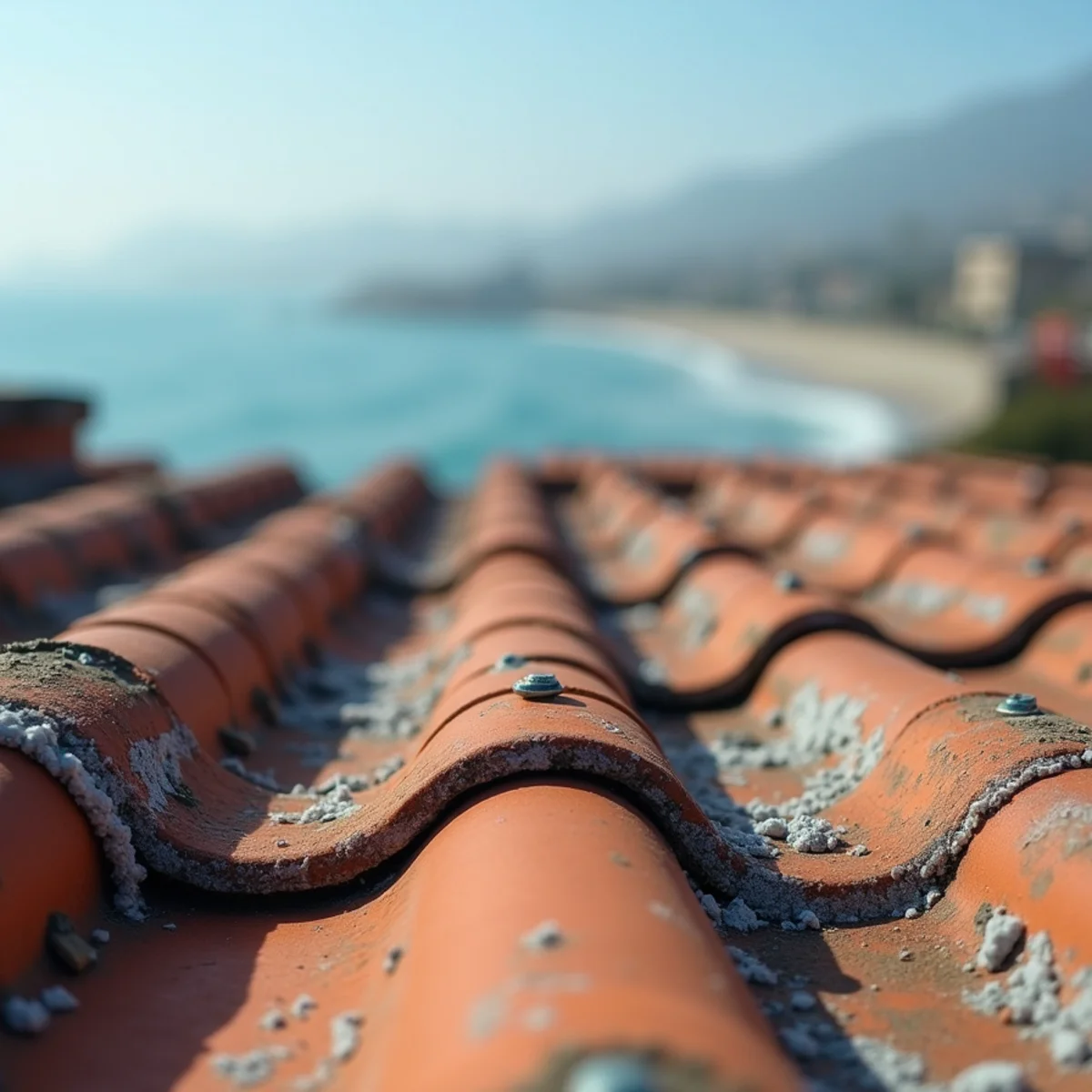
You keep the gutters clear and you have never once seen a drip, yet the roof seems to be showing its age faster than the calendar says it should. Along the Oceanside coast, the usual reason is something you cannot spot from the driveway: salt carried in on the ocean air, settling into every seam and onto every nail. This guide walks through how salt air roof damage really happens, why the small metal parts give out first, and what a homeowner can reasonably do about it.
What salt air does to roofing components
The ocean does not just send you a breeze. Every wave that breaks throws a fine mist of seawater into the air, and as the water evaporates it leaves microscopic salt particles behind. Those particles ride the wind inland and settle onto whatever they land on, including your roof. Salt is hygroscopic, which is a plain way of saying it pulls moisture out of the air and holds it against a surface. On a roof, that means salt-coated metal stays damp far longer than it otherwise would, and damp metal is metal that corrodes.
Corrosion is simply the slow chemical breakdown of metal, the same process that turns bare steel to rust. Salt speeds it up because the salty film helps carry the tiny electrical currents that drive the reaction. So while an inland roof deals mostly with sun and the occasional rain, a coastal roof faces a thin, salty, almost constantly present layer of moisture working on its metal parts. Add the marine layer, the low morning cloud that keeps Oceanside surfaces wet well after inland neighborhoods have dried, and you have close to ideal conditions for coastal roof corrosion.
It helps to picture the roof as a system rather than a single sheet of material. The visible roofing, whether shingle, tile or metal panel, sheds the bulk of the water. Underneath sit the parts that actually keep the house dry: the underlayment, the flashing and the fasteners. Underlayment is the water-resistant sheet laid over the wood decking before the roofing goes on. Flashing is the shaped metal that seals the joints where the roof meets a wall, a chimney or a vent. Fasteners are the nails and screws holding it all down. Salt air goes to work hardest on that hidden metal, which is exactly why the damage stays out of sight for so long.
Fasteners and flashing: the first to fail
Ask an experienced roofer what fails first on a coastal home and the answer is rarely the shingle or tile itself. It is the metal. Fasteners and flashing carry the whole job of keeping water out at the roof's most vulnerable points, and they are usually the smallest, thinnest pieces of metal up there. Once salt corrosion sets in, a fastener loses its grip and a nail head can weaken or pop; a corroded piece of flashing stops sealing and opens a gap. Neither one announces itself, and the roofing above still looks fine from the ground.
That is what makes this failure mode so sneaky. Standard galvanized nails and ordinary flashing that might last for decades in a dry inland setting can give out considerably sooner within sight of the water. We avoid quoting a hard number of years, because the honest answer depends on your distance from the surf, your roof's exposure and the materials used, and regional climate and industry guidance both treat coastal corrosion rates as ranges rather than fixed figures. What stays consistent is the pattern: the hardware fails, water sneaks past, and the first anyone knows of it is a ceiling stain or soft decking found during another repair.
The hidden metal matters most in a few predictable places, which is where a careful inspection tends to focus:
- Valleys, where two roof planes meet and channel a lot of water
- Around chimneys, skylights and vent pipes, where flashing does the sealing
- At the eaves and along the edges, where wind can drive rain upward
- Anywhere a fastener penetrates the roofing and gives salt a path to work on
How distance from the ocean changes risk
Two Oceanside homes only a few miles apart can face very different levels of salt exposure. A property near the harbor or right off the sand takes the full brunt of airborne salt and the longest hours of marine-layer dampness. Move inland toward Fire Mountain, Rancho Del Oro or Ocean Hills and the salt load drops off, though the heat and sun tend to climb. There is no sharp line where salt stops; it is a gradient, heaviest at the water and easing as you go.
This is why blanket advice written for a national audience often misses the mark here, and why roofing near the ocean calls for choices matched to your spot on that gradient. The closer you are to the water, the more it pays to prioritize corrosion-resistant hardware and well-sealed detailing. A little further inland, the salt concern eases and heat management moves up the list. A roofer who works the coast can read your exposure from where the house sits, which way it faces, and how the terrain funnels the wind.
Materials that resist salt best
No roof is immune to salt, but some components handle it far better than others, and the right combination makes a real difference to how long the whole assembly lasts. On the metal side, corrosion-resistant options, certain coated steels and aluminum in particular, are built to shrug off salty air far better than bare or lightly protected metal. Copper is durable but behaves differently in direct salt spray, developing a weathered surface layer that not everyone wants, so it is chosen carefully near the water rather than by default.
Tile is another strong coastal performer. Both clay and concrete tile are largely inert, so the salt that ruins metal has little chemical effect on the tile itself. The catch is that the tile is not the waterproof layer, the underlayment beneath it is, so a tile roof lives or dies by the quality and condition of what is hidden underneath. Asphalt shingles can work near the coast too, provided they are paired with corrosion-resistant fasteners and quality flashing and underlayment. Across every one of these materials the theme repeats: salt air roofing in California succeeds or fails on the hidden metal and the waterproof layer, not the surface on top.
Signs of salt-air damage to watch for
Because the worst of the damage hides beneath the surface, the visible clues are worth knowing. You do not need to climb up to catch most of them; a slow walk around the house with a good look at the roofline, plus an occasional peek into the attic, covers a lot of ground.
- Rust streaks or staining running down from nail heads, flashing or roof vents
- Flashing that looks pitted, flaky, lifted or discolored around chimneys and skylights
- Fasteners that have backed out, leaving raised bumps in the roofing surface
- Granules from asphalt shingles collecting in gutters faster than expected
- Damp spots, daylight or a musty smell in the attic after a rain
- Ceiling stains inside, which usually mean water has already been getting in for a while
What to do about it
The practical response to salt air is not worry; it is a routine. A periodic professional roof inspection is the single most useful habit for a coastal roof, because a trained eye catches early corrosion at flashing and fasteners long before it turns into interior damage. Late summer is a sensible time for an annual look, after the dampest marine-layer months and before the winter rains arrive.
Between inspections, a few simple things help: keep gutters and valleys clear so water drains instead of pooling against metal, rinse salt off accessible surfaces where practical, and treat moss or mildew on shaded planes before it holds moisture against the roof. And when it comes time for a repair or replacement, the coastal upgrade that matters most is specifying corrosion-resistant fasteners and flashing from the start, a modest cost at installation and one of the biggest factors in how long the roof holds up this close to the water.
If you are unsure where your home falls on the exposure scale, or you have noticed any of the warning signs above, a straightforward inspection will tell you where you stand, with no scare tactics, just a clear look and a sensible plan.
Frequently asked questions
Sources & further reading
- NOAA / National Weather Service coastal climate data
- NRCA coastal installation guidance
This article is general guidance. Confirm current code, permit, Title 24, insurance and warranty specifics with the relevant authority for your project.