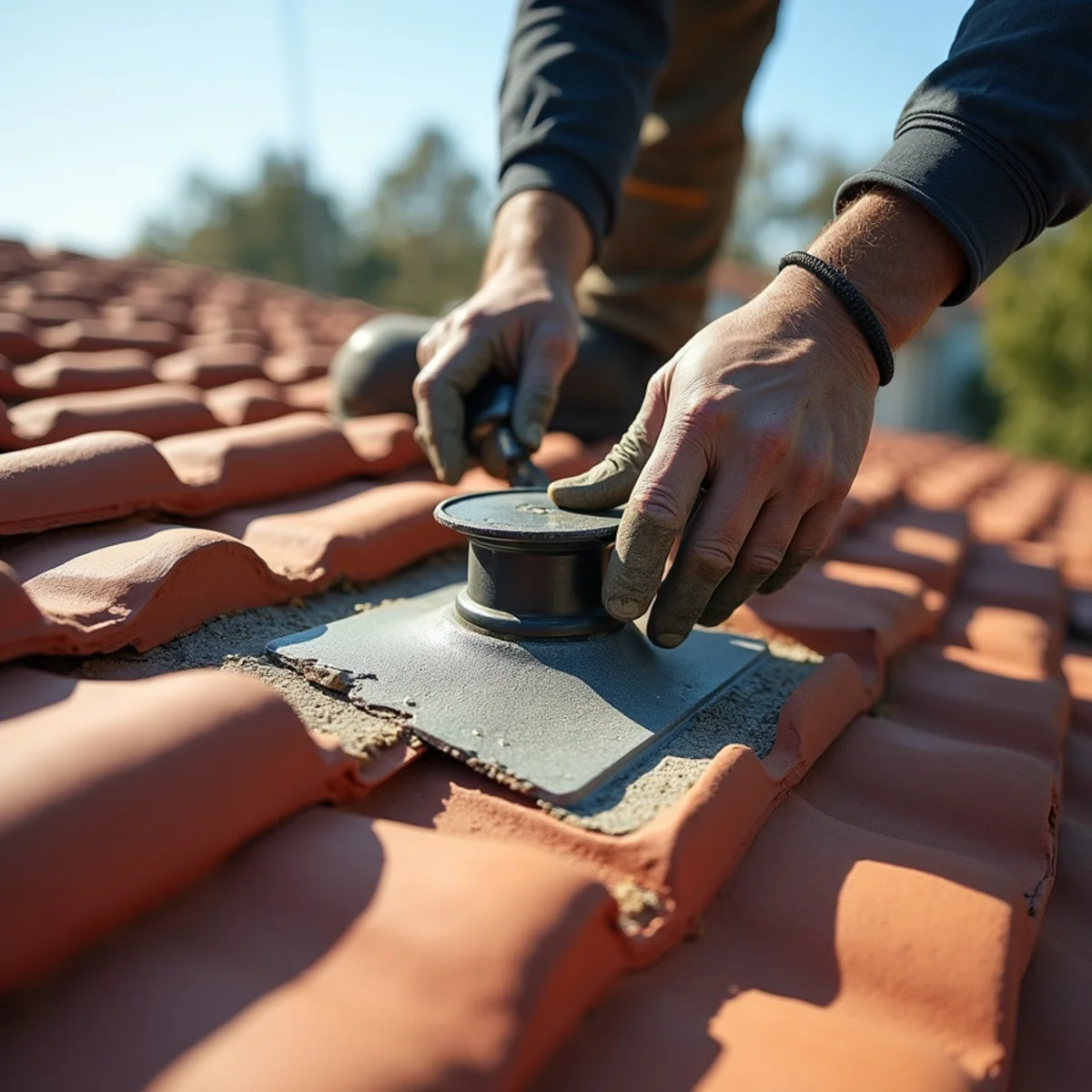
A leaking roof feels like a verdict — proof that the whole thing has given out and needs replacing. In reality, the roofing surface is often sound, and the water is slipping in at a specific weak point that a focused repair can address. Across Southern California's coastal homes, most leaks trace back to a short list of usual suspects, and the roofing material simply wearing out is rarely first on it.
Failed flashing
Flashing is the thin, formed metal that seals the joints where the roof surface meets something else: a chimney, a sidewall, a skylight, a vent or the valley between two slopes. These transitions cannot be waterproofed by shingles or tile alone, so flashing bridges the gap and directs water back onto the roof. When it fails, water pours straight into the seam it was meant to seal, which is why failed flashing is one of the most common roof leak sources of all.
Flashing fails for a few reasons. It can be lifted or bent by wind, worked loose as a building expands and contracts, sealed originally with a caulk that has since dried and cracked, or simply corroded through. Near the Oceanside coast, corrosion is the accelerant. Salt-laden air eats at standard metal flashing faster than it would inland, so flashing that might have lasted for decades a few miles from the water can start leaking sooner close to it. Because flashing sits at the busiest joints on the roof, it is worth checking first when a leak appears near a chimney, wall or skylight.
Roof penetrations and skylights
Anything that pokes up through the roof surface is called a penetration — plumbing vent pipes, exhaust and attic vents, electrical conduits, chimneys and skylights all count. Each one interrupts the continuous surface that keeps water out, and each is sealed with some combination of flashing, a rubber or metal boot, and sealant. Those seals are among the hardest-working and shortest-lived parts of a roof.
Pipe boots are a frequent offender. The rubber collar that wraps a vent pipe dries out and cracks under years of sun, and once it splits, water runs down the pipe and into the attic. Skylights leak when their perimeter flashing or seals fail, and homeowners sometimes blame the glass when the real issue is the frame's connection to the roof. When you are troubleshooting why roofs leak, the penetrations deserve a close look — there are usually several of them, and any one can be the culprit.
Worn or missing shingles
On an asphalt-shingle roof, the shingles themselves do wear out, and that wear eventually lets water through. Years of strong California sun break down the asphalt binders and strip away the protective granules, leaving shingles brittle, curled or cracked. Wind can then tear the weakened shingles off entirely, exposing the water-resistant layer or the bare wood decking — the sheathing the roofing is fastened to — beneath.
A single missing shingle does not always cause an immediate leak, because there is usually a water-resistant layer underneath — but it removes a line of protection and invites trouble at the next hard rain. Widespread granule loss, curling at the edges and bald patches are signs the roofing is aging as a whole, which shifts the conversation from a spot repair toward planning for a replacement. A few shingles lost to a wind event, by contrast, is often a straightforward fix.
Tile underlayment failure
Tile roofs cause a lot of confusion, because a tile roof can look perfect and still leak. The reason is that the tile is not actually the waterproof layer. Clay and concrete tiles shed the bulk of the water and shield everything below from sun and impact, but the true barrier is the underlayment — the water-resistant membrane laid over the decking, beneath the tile. That hidden layer is what stops water from reaching the wood.
Underlayment has a shorter life than the tile above it, and near the coast the marine layer's persistent dampness ages it faster. When it dries out, cracks or tears, water that gets past the tile — as some always does during heavy or wind-driven rain — reaches the decking and finds its way inside. The tiles can be entirely intact while this happens, which is why a leaking tile roof does not necessarily need new tile. Often the existing tile can be lifted, the underlayment renewed, and the tile reset, depending on its condition.
Clogged drainage
A roof only works if water can leave it quickly, and anything that blocks the exit invites a leak. Leaves, needles, granules and windblown debris collect in gutters, in valleys — the V-shaped channels where two roof planes meet — and around penetrations. When those channels clog, water backs up, slows down and sits where it should be flowing away.
Standing water is a problem because roofing is designed to shed water, not to hold it. Backed-up water can wick under the lower edges of shingles or tile, overtop flashing, and soak into the roof from angles the system was never meant to resist. On flat and low-slope roofs, poor drainage shows up as ponding — shallow pools that linger for a day or more after rain and slowly stress the membrane. Keeping gutters, valleys and drains clear is one of the simplest ways to prevent leaks.
- Clogged gutters that overflow or back water up under the roof edge
- Debris packed into valleys where two slopes meet
- Ponding water that lingers on flat or low-slope roofs after rain
- Blocked or undersized downspouts that cannot carry water away
Wind damage
Wind is the cause people underestimate most, partly because its damage does not always leak right away. The mechanism is wind uplift: as wind moves across a roof, it creates suction that can lift the edges of shingles or work tiles loose, breaking the seal that holds everything down. Hot, dry Santa Ana conditions are especially hard on Southern California roofs, lifting shingles and cracking or dislodging tiles, and sometimes flinging debris that chips or breaks the surface.
The tricky part is timing. A roof can be compromised by a wind event while still looking fine from the ground, and the leak may not appear until the next rain finds the opening. That delay is exactly why a ground-level check after a strong Santa Ana event is worthwhile, even when you see no water inside. Catching lifted shingles or a slipped tile before the rain arrives turns a potential leak into a minor repair.
Frequently asked questions
Sources & further reading
- NRCA leak-source guidance
This article is general guidance. Confirm current code, permit, Title 24, insurance and warranty specifics with the relevant authority for your project.