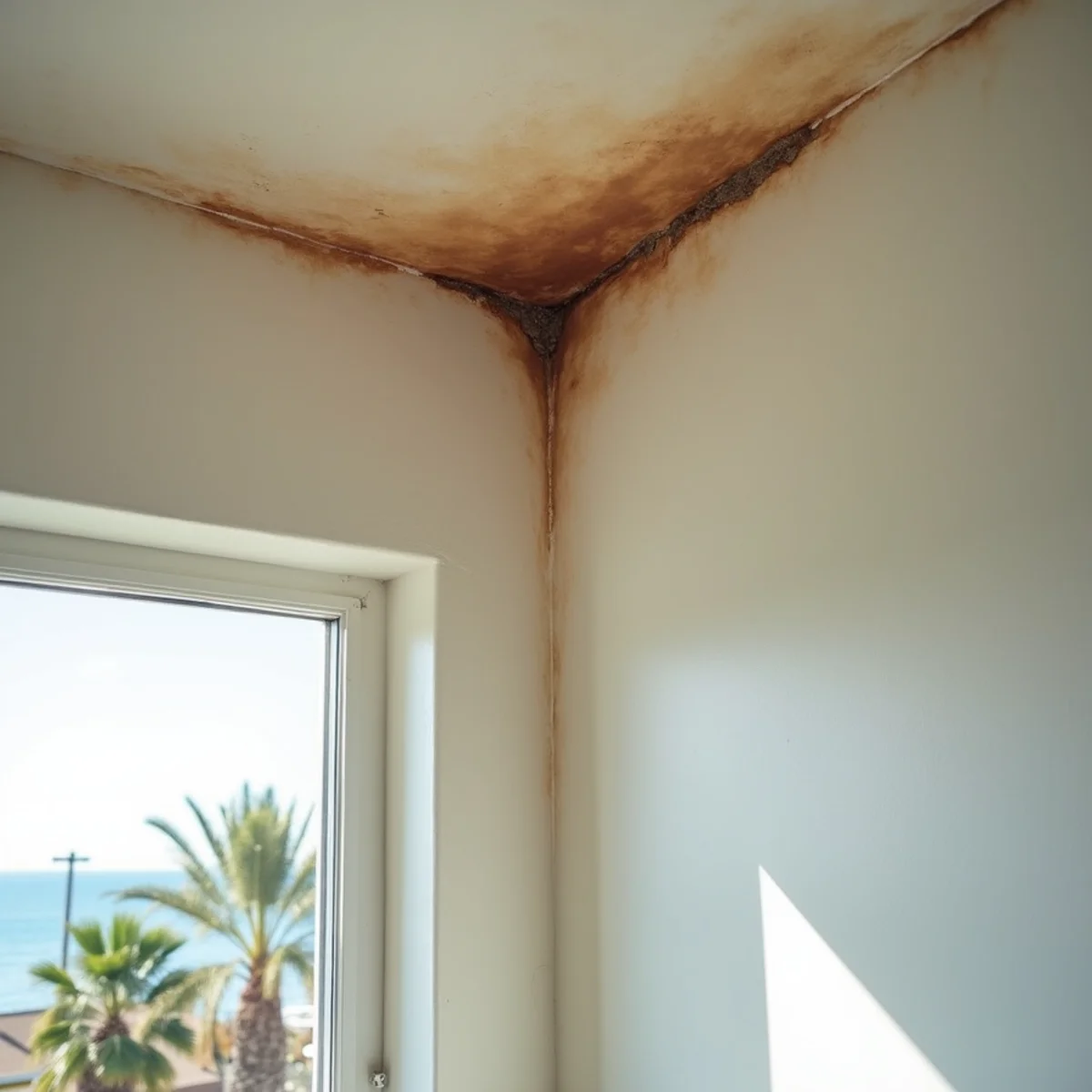
A roof leak rarely announces itself where it begins. Water slips in through a small opening high on the roof, then runs along the underside of the sheathing and down the framing before it finally shows up as a stain on a ceiling somewhere else entirely. That single fact — that the wet spot you see is almost never directly below the true entry point — is why so many Oceanside homeowners misjudge a leak, or miss it until the damage has already spread.
Interior signs to watch for
The signs of a roof leak usually start small inside the house, and they are easy to explain away as something else. A faint brown ring on the ceiling, a patch of paint that has started to bubble, a corner of drywall that feels soft — each can look minor on its own. Taken together, and especially if they appear or grow after rain, they are among the most common roof leak symptoms worth taking seriously.
Discoloration is the classic tell. Water passing through drywall and paint leaves a yellow, brown or coppery stain, often with a darker ring at the edge where the moisture repeatedly stopped and dried. You might also notice paint or wallpaper peeling away from the wall, a bulge in the ceiling where water has pooled above it, or a persistent musty smell in a room that should be dry. That odor matters because it can mean moisture is present even when you cannot yet see a stain.
- Yellow, brown or ring-shaped stains on ceilings or the tops of walls
- Paint or wallpaper that is bubbling, blistering or peeling
- A soft, sagging or bulging spot in the ceiling
- A damp, musty smell that lingers, particularly after rain
- Recurring mold or mildew in one corner of a room
Attic clues
If you have attic access and it is safe to reach, the attic is the best place to catch a leak early — often long before it reaches a finished ceiling. On a dry day, bring a flashlight and look at the underside of the decking, which is the wood sheathing (usually plywood or older plank boards) that your shingles or tiles are fastened to. Water stains, dark streaks and discoloration on that wood point to moisture coming through from above.
Run the light along the rafters and the decking seams, and check the insulation below. Damp, matted or compressed insulation is a strong indicator that water has been coming through, since insulation holds moisture and flattens where it gets wet. Rusted or discolored nail tips poking through the decking are another clue — near the coast, salt-laden air already works on metal fasteners, and added moisture speeds the corrosion. In a dark attic, a pinhole of daylight coming through the roof is a literal sign of an opening.
- Water stains or dark streaks on the underside of the decking or on rafters
- Damp, matted or discolored insulation
- Rusted nail tips or corroded metal connectors
- Daylight visible through the roof deck
- A damp or musty smell concentrated in the attic
Exterior signs
From the outside, the goal is to spot roofing that is no longer doing its job — but you should do this from the ground, from a window or with binoculars. Do not climb onto the roof to investigate. A roof that may already be compromised, or one that is wet or has fragile tiles, is genuinely dangerous to walk, and the view from the ground tells you most of what you need to know.
On a shingle roof, look for shingles that are missing, curling at the edges, buckling or lying crooked, along with bare patches where the protective granules have worn away. On a tile roof, watch for cracked, chipped or slipped tiles — a tile that has slid out of line leaves a gap. Pay attention to flashing, the thin metal pieces that seal the joints where the roof meets a chimney, a wall, a skylight or a vent; flashing that is lifted, rusted or pulling away is a frequent starting point for leaks. Valleys — the V-shaped channels where two roof slopes meet and shed a lot of water — are another common trouble spot, especially when they collect leaves and debris.
Overflowing or granule-filled gutters and downspouts are worth noting too. When gutters clog, water can back up under the lower courses of roofing, and the sediment washing out of them can tell you a shingle roof is aging.
- Missing, curled, cracked or buckled shingles, or heavy granule loss
- Cracked, chipped or slipped tiles, or visible gaps in the tile field
- Flashing that is lifted, rusted, bent or separating from the surface
- Debris packed into valleys or gutters, which backs water up under the roofing
- Sagging rooflines or dips visible along the ridge
Why the drip isn't under the damage
Here is the part that trips up almost everyone. Water is patient, and it follows gravity and the path of least resistance rather than a straight line. It can enter at a failed flashing near the chimney, run several feet along a rafter or across the top of the decking, drop onto a ceiling joist, travel farther still, and only then soak through the drywall. By the time you see the stain, the actual opening may be well uphill and off to one side of it.
This is why chasing a leak by looking straight up from the stain so often fails, and why a patch applied to the wrong spot does nothing at all. It is also why a coastal roof deserves a careful diagnosis rather than a guess. Finding the true entry point means tracing the water back along its path — reading the stains in the attic, checking the roof details above them, and accounting for how the roof drains. It is detective work, and it is the single biggest reason a professional look pays off on a leak you cannot pin down yourself.
What to do when you spot a leak
If you have found signs of a leak, the priority is to limit the damage and get an accurate diagnosis — not to climb up and hunt for the hole yourself. Inside, you can move furniture and valuables out of the way and set a container under an active drip to catch the water. If a ceiling is bulging with trapped water and it is safe to do so, some homeowners relieve the pressure by making a small hole at the low point to drain it into a bucket, which can prevent a larger collapse; if you are unsure, keep clear of the area and wait for help.
From there, a documented roof inspection is the sensible next step. It identifies the real source, shows you the extent of the problem, and lets you decide on a repair with the full picture in hand. If the leak is active during a rainstorm and getting worse, you can call (209) 758-8550 to check current urgent-service availability. For a slower, intermittent leak, scheduling an inspection before the next storm is usually enough.
- Contain the drip and protect belongings, but stay off the roof
- Photograph the interior signs and any stains for your records
- Note when the leak appears — steady rain, wind-driven rain or all the time — which helps with diagnosis
- Arrange a professional roof inspection to find the true source
- For an active, worsening leak during a storm, call to check current urgent-service availability
Frequently asked questions
Sources & further reading
- NRCA leak diagnosis guidance
This article is general guidance. Confirm current code, permit, Title 24, insurance and warranty specifics with the relevant authority for your project.