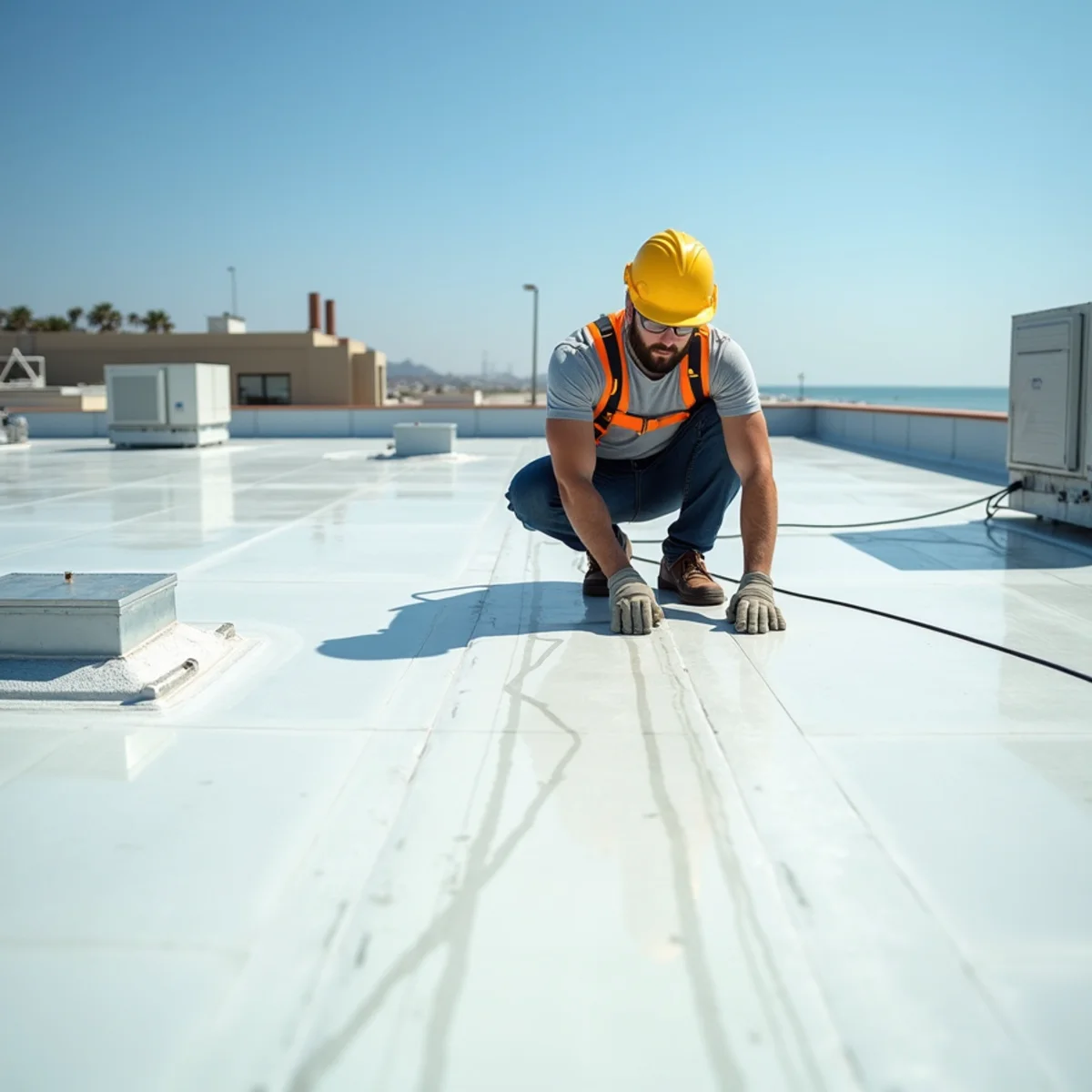
On a commercial building, the roof is easy to forget until it makes itself impossible to ignore — usually with a leak over an occupied space and a repair bill that arrives at the worst possible time. Reactive fixes almost always cost more than planned upkeep, both in dollars and in disruption. This guide lays out what flat roof maintenance looks like for an Oceanside commercial property, and why a steady rhythm pays off.
Why flat roofs need proactive care
A commercial building's roof is usually flat or low-slope — a roof with just enough pitch to move water toward drains, nowhere near the angle of a house roof. Low-slope means it cannot rely on steepness to shed rain. Instead it depends on a continuous waterproof membrane — a single, sealed skin of material across the whole roof, often a single-ply sheet — and on drains that actually carry water away. Because the entire surface is doing the waterproofing, a small failure almost anywhere on it can let water in.
That is what makes commercial flat roof upkeep different from patching a house roof. A low-slope roof rarely fails all at once; it gives out gradually at the details — a seam that has crept open, a drain that has silted up, flashing that has dried and cracked. Caught early, each of these is a minor, inexpensive fix. Left alone, they let water into the insulation and deck below, where damage spreads out of sight and a small repair becomes a section replacement. Add Oceanside's coastal conditions — salt in the air, a damp marine layer most mornings, strong sun the rest of the day — and the case for staying ahead of wear only gets stronger.
Drainage and ponding
Water is supposed to leave a flat roof, and the single most important thing maintenance does is make sure it can. When it cannot, you get ponding — water that sits in a low spot for more than a day or two after rain instead of draining away. Ponding is hard on a roof: standing water is heavy, it breeds algae and growth, and it works on the membrane and its seams until they give. On the coast, a marine layer that keeps surfaces damp only lengthens the time water lingers.
- Keep drains, scuppers and gutters clear of leaves, silt, seabird debris and windblown litter
- Check that drain strainers are in place and neither clogged nor broken
- Watch for ponding after rain — rings, silt lines and darker stains mark where water sits
- Note any low spots that hold water and flag them before the membrane suffers
- Clear debris from the whole surface, since it migrates toward drains and blocks them
Seam and flashing inspection
If drainage is the first thing to check, seams and flashing are the second. A seam is the line where two sheets of membrane join, and it is the weakest part of any single-ply roof — years of sun and the daily expansion and contraction of the material can pull a seam apart. Flashing is the material that seals the membrane up and over parapet walls, curbs, drains and every penetration through the roof. Coastal salt corrodes metal flashing and dries out the sealants that finish it, so on an Oceanside roof these details deserve regular attention.
- Walk the seams looking for lifting, wrinkling, gaps or any spot that has opened
- Inspect flashing at parapet walls, curbs and roof edges for lifting, cracks or corrosion
- Check every penetration — pipes, vents, drains, conduit, rooftop units — where the seal is made by hand and ages first
- Look for blisters or bubbles in the membrane, where moisture or trapped air has lifted it
- Note punctures or scrapes near rooftop equipment that gets serviced
Coatings and restoration
When a low-slope roof is worn on the surface but still solid underneath, a coating can renew it without a full tear-off. A roof coating is a liquid applied over the existing membrane that cures into a continuous, flexible skin — a fresh waterproof surface with no seams, which matters because seams are where these roofs most often leak. A light-colored reflective coating also bounces back a good share of the sun, which can lower the roof's temperature and ease cooling costs on a big, sun-exposed commercial building.
A coating is a renewal, though, not a rescue. It restores a surface that is watertight or close to it and dry underneath; it cannot fix a roof that has already let water into its insulation, because sealing wet insulation under a fresh skin just traps the moisture. Whether restoration is the right move depends on the condition beneath the surface, which is one more reason regular inspection matters — it tells you whether your roof is still a candidate for a coating or has moved past it. Where a coating fits, it is one of the more cost-effective ways to add years to a commercial roof with minimal disruption to the business below.
Building a maintenance plan
The point of all this is to replace surprises with a schedule. A maintenance plan turns roof care from something that happens after a leak into something that happens on a calendar, and for a property manager it also produces the documentation that makes budgeting and ownership records easier.
- Regular scheduled inspections — a common rhythm is twice a year, plus a check after any major storm or wind event
- Routine drain and gutter clearing, so water always has a way off the roof
- Seam, flashing and penetration checks, with small repairs handled before they spread
- A written record of each visit, with photos, so roof condition is tracked over time
- A realistic horizon for larger work, so a recoat or replacement lands as a planned project rather than an emergency
- Scheduling that respects the building's hours, keeping disruption to tenants and staff low
Documentation is worth singling out. A dated record of what was found and fixed helps you plan budgets, supports the building's ownership file, and makes it far easier to see a problem developing over several visits rather than discovering it all at once. Done consistently, low-slope roof maintenance is not so much an expense as a way of controlling when and how you spend on the roof — planned, predictable, and far less costly than waiting for the ceiling to tell you something is wrong.
Frequently asked questions
Sources & further reading
- NRCA low-slope maintenance guidance
This article is general guidance. Confirm current code, permit, Title 24, insurance and warranty specifics with the relevant authority for your project.